Porter’s Five Forces Analysis PowerPoint
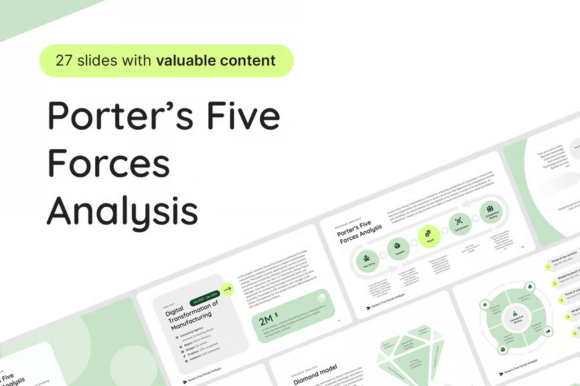
Porter’s Five Forces Analysis PowerPoint is a ready-to-use, professionally designed presentation toolkit built for clarity, adaptability, and real-world application. It’s not just a set of slides—it’s a strategic framework made visual: 27 unique, editable slides covering every element of Michael Porter’s model—New Entry, Supplier Power, Buyer Power, Substitution Threat, and Competitive Rivalry—plus supporting templates like Agenda, Roadmap, Infographic, Gallery, Testimonials, Pricing Tables, Contact Information, and an About Us slide.
Why This Matters—Depending on Who You Are
If you’re a startup founder preparing for investor talks, Porter’s Five Forces Analysis PowerPoint helps you articulate industry risk and opportunity in under five minutes—not with jargon, but with clean visuals that anchor your story. A marketing manager might use the Roadmap for Developing a Company’s Porter’s Five Forces Analysis slide to align cross-functional teams before launching a new product line. For educators, the About Us Template and Infographic Slide serve as teaching anchors—students can populate them during class exercises, reinforcing theory through active design.
A freelance consultant may prioritize speed and polish: two-click customization means swapping colors, resizing shapes, or updating text without wrestling with layers or external software. No Photoshop. No Illustrator. Just native PowerPoint—fully compatible with 2010 through Microsoft 365—and retina-ready for crisp projection or screen sharing.
What Makes It Work for Different Skill Levels
Beginners appreciate the Porter’s Five Forces Analysis Blank Template—a structured canvas with labeled placeholders, intuitive icons, and clear prompts. There’s no guessing where “Supplier Power” fits in the flow. Paired with the included Detailed Instructions, it becomes a self-guided learning tool—not just a deliverable.
Experienced strategists value flexibility over hand-holding. They’ll use the Diamond Model Structure Scheme alongside the Five Forces slides to compare national competitiveness drivers (like factor conditions or firm strategy) with industry-level pressures. The editable shapes let them layer custom data points, annotate trends, or merge forces into hybrid frameworks—without breaking slide consistency.
Content creators and educators rely on visual coherence. With free Google Fonts pre-loaded and a one-click color-theme builder, they can match slides to brand guidelines—or classroom themes—in under two minutes. Apply that palette across all 27 slides instantly. That’s time saved on formatting, reinvested in insight.
Six Real-World Benefits You Can Analyze—Not Just Display
This isn’t about making pretty charts. It’s about enabling analysis. Here’s how each benefit translates into actionable understanding:
- Spotting hidden entry barriers—e.g., a local café chain assessing whether delivery app fees and kitchen space constraints constitute stronger “New Entry” hurdles than brand loyalty alone.
- Mapping supplier leverage—a SaaS company evaluating whether its reliance on one cloud infrastructure provider weakens its pricing power with enterprise clients.
- Anticipating buyer shifts—a B2B training provider noticing rising demand for micro-credentials, signaling growing “Buyer Power” via increased comparison tools and lower switching costs.
- Quantifying substitution risk—a fitness studio analyzing whether on-demand apps, wearable feedback loops, or community-led runs meaningfully erode its service uniqueness.
- Reading competitive intensity—a regional solar installer using the Competitive Rivalry slide to benchmark ad spend, service bundling, and warranty terms against five local peers.
- Aligning internal priorities—an HR team applying the Agenda Template and Roadmap Slide to sequence workforce planning around projected industry consolidation.
Design That Serves Strategy—Not Just Aesthetics
Every shape is editable—no grouped objects, no locked layers. Resize a force diagram, recolor an icon, adjust spacing between columns in the Pricing Tables Template—all within PowerPoint. The 16:9 HD layout ensures readability on laptops, projectors, and virtual meeting screens. And because it uses open, web-safe fonts (with Google Font alternatives embedded), your slides render consistently—no missing typefaces, no last-minute substitutions.
The Gallery Template isn’t decorative filler. It lets you showcase competitor screenshots, customer quotes, or regulatory timelines side-by-side—turning qualitative evidence into part of the Five Forces narrative. Likewise, the Testimonials Template supports credibility: embed actual client feedback next to the relevant force (“After mapping our supplier concentration, we renegotiated contracts with three vendors”—CFO, Manufacturing Co.).
When to Reach for This—And When to Pause
This template shines when you need to communicate analysis quickly, teach the model concretely, or iterate strategically across teams. It’s ideal for quarterly reviews, pitch decks, academic presentations, or internal workshops.
It’s less suited if you need deep quantitative modeling (e.g., regression-based bargaining power scores) or live data integration (like Excel-linked charts). But it does integrate smoothly: paste your own charts into the Infographic Slide, drop logos into the About Us Template, or insert real KPIs into the Roadmap.
Small business owners often tell us they use the Contact Information Template not just for “contact us” slides—but as a stakeholder map: tagging key suppliers, regulators, or channel partners beside their relative influence in each force.
Your Next Step Is Practical—Not Purchasing
You don’t need to master Porter’s theory before opening the file. Start with the Blank Template, pick one force—say, “Substitution”—and fill in two real examples from your work this week. Then try the Infographic Slide to visualize how those examples connect. That’s how understanding takes root: not through memorization, but through immediate, low-stakes application.
Whether you’re sketching strategy on a napkin or presenting to a boardroom, Porter’s Five Forces Analysis PowerPoint meets you where you are—no design degree required, no subscription needed, no hidden complexity. Just clarity, control, and the freedom to focus on what matters most: your analysis.