EDITABLE 1990 Birthday Vintage Newspaper: A Thoughtful, Customizable Way to Celebrate Milestones
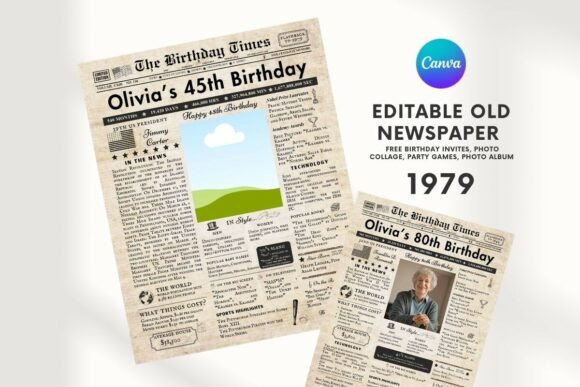
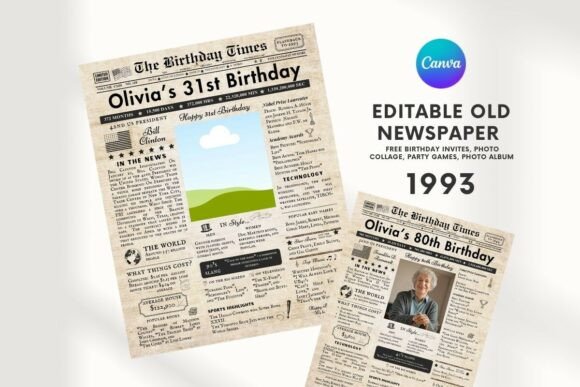
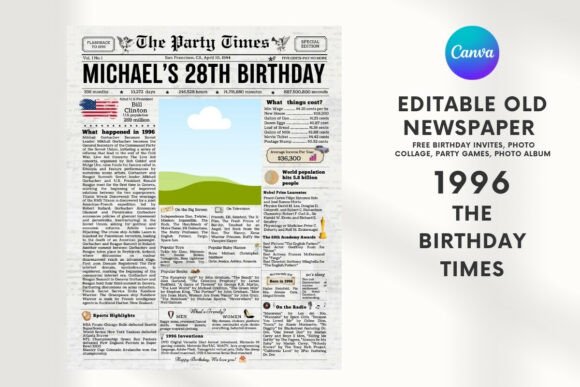
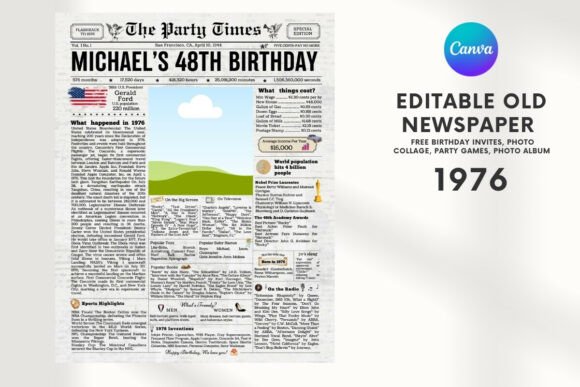
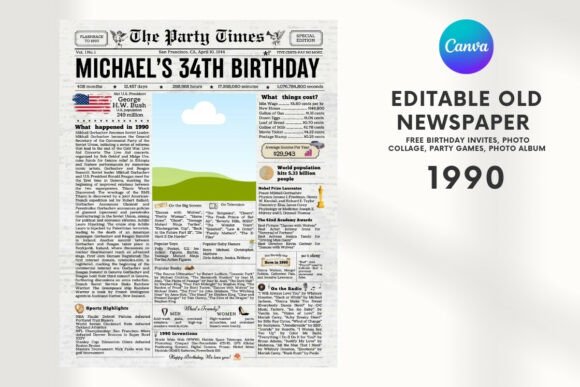
Imagine opening a newspaper dated the day someone was born—complete with period-accurate typography, subtle sepia tones, and headlines that tell their personal story. The EDITABLE 1990 Birthday Vintage Newspaper is a digital template designed for exactly that: a tactile, nostalgic, and deeply personal celebration tool. Built for Canva, it’s not a static printout or pre-written article—it’s a fully customizable layout that invites users to fill in real memories, milestones, and inside jokes. Its 1990 aesthetic isn’t just decorative; it anchors the design in a specific cultural moment—think dial-up internet, grunge music, early mobile phones—making it especially resonant for people turning 34–35 in 2024.
What Sets This Template Apart from Other Birthday Keepsakes
Most birthday commemorative tools fall into two broad categories: generic digital cards (often animated or cartoonish) and rigid printed memorabilia (like framed birth announcements or engraved plaques). The EDITABLE 1990 Birthday Vintage Newspaper occupies a distinct middle ground. It combines the authenticity of vintage print media with the flexibility of modern design software. Unlike fixed-layout PDFs or one-size-fits-all posters, this template uses Canva’s drag-and-drop interface—so text, photos, fonts, and colors can be adjusted without design experience. You’re not choosing between “cute” or “elegant”; you’re shaping tone, pacing, and emphasis as you would writing a short feature story.
Its structure mirrors a real newspaper: a masthead (“The Daily Memory,” “The Yearbook Herald”), front-page “breaking news” about the celebrant’s birth, an obituary-style “Life So Far” column (playfully written), weather reports referencing childhood hometowns, and even mock classifieds listing favorite foods or songs. These sections aren’t gimmicks—they serve as gentle prompts for reflection. That makes the EDITABLE 1990 Birthday Vintage Newspaper more than decoration; it’s a light-touch storytelling framework.
How It Compares to Other Personalization Options
Compared to photo books or scrapbooks, this template requires less time investment and fewer physical materials. There’s no need to source paper stock, bind pages, or arrange physical clippings. Yet it avoids the disposability of many digital invites—because it’s meant to be printed and handled, it carries weight that a slideshow or social media post doesn’t.
When weighed against custom illustration services or professional graphic design commissions, the EDITABLE 1990 Birthday Vintage Newspaper trades bespoke artistry for accessibility and speed. A designer might craft something more unique or nuanced—but at several hundred dollars and weeks of turnaround. This template delivers strong visual cohesion and era-specific charm in under two hours, assuming moderate Canva familiarity.
It also differs from AI-generated birthday content. While AI tools can draft witty bios or timelines quickly, they often lack consistent voice, historical texture, or intentional layout rhythm. The EDITABLE 1990 Birthday Vintage Newspaper provides scaffolding: the structure guides content creation, reducing decision fatigue while preserving human voice and specificity.
Strengths—and Where It Has Limits
Its biggest strength lies in emotional resonance through constraint. The 1990 theme isn’t arbitrary—it gives creators shared reference points (e.g., “Top 5 Hits the Week You Were Born”) that spark conversation and recognition. That shared cultural shorthand helps guests connect faster, especially across generations. A grandparent may recall the Gulf War headlines; a millennial guest remembers Tamagotchis; the birthday person themselves might laugh at references to floppy disks or VHS rewind buttons.
However, that same specificity is also a limitation. If the celebrant wasn’t born in 1990—or strongly identifies with another decade—the template’s aesthetic may feel misaligned. While colors and fonts can be adjusted, the core layout assumes a late-20th-century newspaper vernacular: serif headlines, justified columns, minimal whitespace. That won’t suit every personality. Someone who prefers minimalist, modern, or abstract aesthetics may find it overly busy or retro in ways that don’t reflect their identity.
Also, printing quality depends on user choices. The template works best on matte or uncoated paper (to mimic newsprint), but home printers may struggle with fine halftone textures or dense grayscale areas. For archival longevity, professional printing is recommended—adding cost and lead time that some planners may not anticipate.
When It’s the Right Fit—and When to Look Elsewhere
The EDITABLE 1990 Birthday Vintage Newspaper shines in three scenarios:
- Milestone birthdays with narrative weight—30th, 40th, 50th, or retirement celebrations where guests appreciate layered storytelling and intergenerational appeal.
- Hybrid events—parties that blend in-person gathering with take-home keepsakes, like weddings or reunions where guests value tangible mementos.
- DIY-minded planners who want polish without outsourcing—people comfortable with Canva but not graphic design software, seeking consistency without hiring help.
Conversely, it may not be ideal if:
- You’re planning a very small, intimate gathering where simplicity matters more than thematic depth.
- The celebrant dislikes nostalgia—or associates 1990s culture with negative personal memories (e.g., family upheaval, economic hardship).
- You need multilingual support: the template’s layout assumes left-to-right, Roman-alphabet text flow and doesn’t easily accommodate right-to-left scripts or complex line breaks.
- Accessibility is a top priority: while readable, the newspaper style uses smaller type sizes and lower-contrast grayscale elements that may challenge some visually impaired readers without modification.
Practical Tips for Getting the Most Out of the Template
Start by gathering concrete details—not just “born in Chicago,” but the hospital name, weather that day, top song on the charts, and a local headline from the region. Sites like Newspapers.com or the Library of Congress’ Chronicling America archive offer free access to digitized 1990 papers, which can inspire authentic section headers or tone.
Resist overloading every column. A vintage newspaper feels authentic partly because it leaves breathing room—white space, modest margins, and varied paragraph lengths. Prioritize 3–4 meaningful stories over exhaustive lists. One well-told anecdote about learning to ride a bike beats ten bullet points of school grades.
If printing at home, test one page first. Adjust brightness/contrast in Canva’s image settings if grayscale areas look muddy. For group contributions, share the Canva link with edit access and assign sections (e.g., “Aunt Lisa handles ‘Childhood Highlights,’ cousin Marco writes ‘Top 5 Life Lessons’”). That distributes effort while keeping voice consistent.
A Tool That Supports Meaning—Not Just Decoration
The EDITABLE 1990 Birthday Vintage Newspaper doesn’t replace heartfelt conversation or presence—it supports it. By giving people a shared format to reflect, contribute, and commemorate, it lowers the barrier to meaningful participation. It’s not about replicating 1990; it’s about using that era’s visual language to say, “Your life has context, continuity, and community.”
That makes it worth considering—not as the only option, but as one thoughtful, adaptable choice among many. Whether used as a centerpiece display, a guestbook alternative, or a personalized party favor, its value emerges most clearly when aligned with intention: celebrating not just age, but arc, affection, and attention to detail.