Why the EDITABLE 1996 Birthday Vintage Newspaper Is Reshaping Personalized Celebration Design
In an era where digital fatigue is real and attention spans are fragmented, meaningful connection has become the ultimate currency—especially in celebration design. Enter the EDITABLE 1996 Birthday Vintage Newspaper: not just a novelty template, but a strategically resonant creative tool that bridges nostalgia, personal storytelling, and modern DIY empowerment. Designed for professionals, creators, and thoughtful hosts alike, this Canva-based resource transforms how we commemorate milestones—not through mass-produced greetings, but through bespoke, tactile, and emotionally intelligent design.
A Digital Artifact Rooted in Analog Warmth
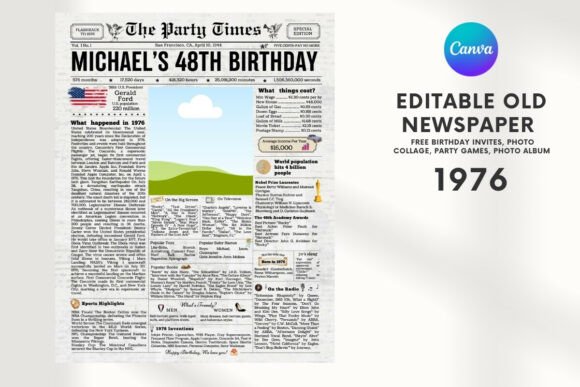
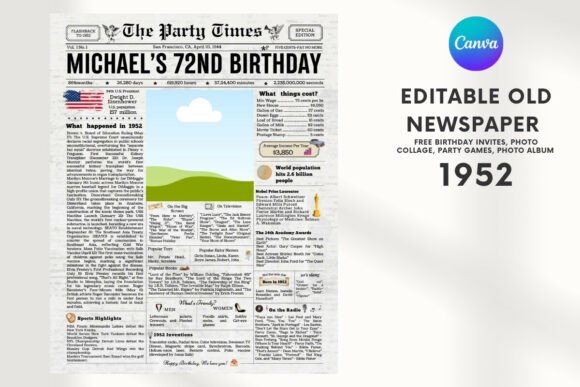
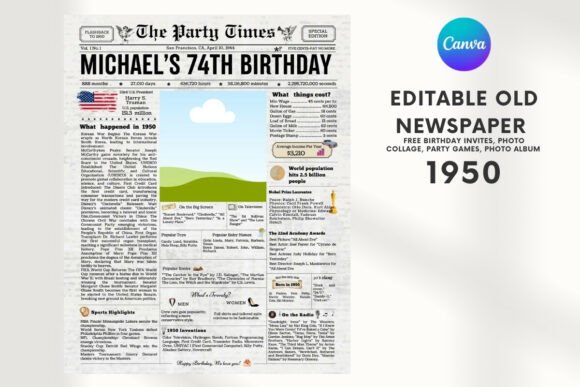
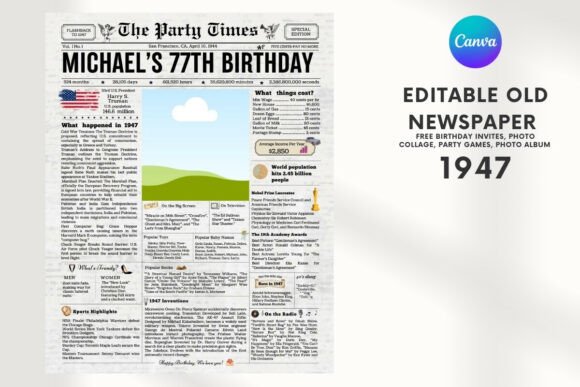
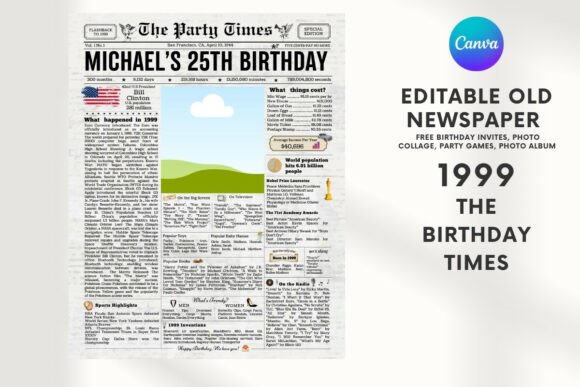
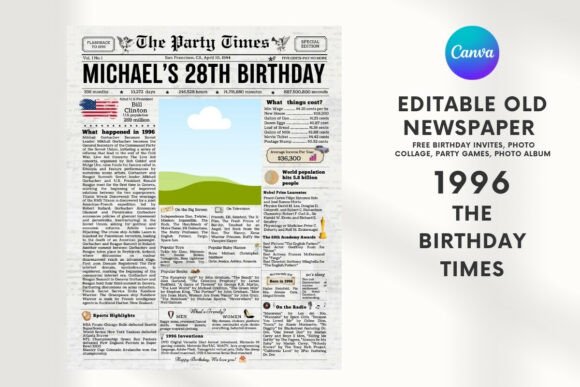
The EDITABLE 1996 Birthday Vintage Newspaper is a fully customizable, downloadable Canva template styled to evoke the typography, layout, and visual texture of mid-90s print journalism. It’s not a static image or PDF—it’s a live, editable document with layered text boxes, period-appropriate fonts (think serif headlines and typewriter-style body copy), vintage-inspired borders, and modular sections for headlines, “breaking news” announcements, feature stories, and archival photos. Users don’t just fill in blanks; they curate a narrative—crafting a front page that declares, “Today, [Name] Turns 30,” followed by imagined “coverage” of their life’s highlights: early triumphs, defining quirks, career leaps, and quiet joys.
This isn’t retro for retro’s sake. The 1996 aesthetic carries deliberate resonance: it predates social media saturation, predates algorithmic curation, and evokes a time when information felt earned—not scrolled. That authenticity translates directly into emotional impact—making the celebrant feel seen, remembered, and celebrated on human terms.
Aligning With Macro Trends in Creativity and Consumer Expectations
The rise of tools like the EDITABLE 1996 Birthday Vintage Newspaper reflects broader shifts across multiple domains:
- Creative Democratization: Platforms like Canva have moved beyond basic graphic design into narrative scaffolding—offering templates that guide storytelling structure, not just visual alignment. This lowers the barrier for non-designers while raising the ceiling for expressive precision.
- Nostalgia as a Design Language: Research from McKinsey & Company notes that “authentic nostalgia”—grounded in specific, sensory-rich eras—drives engagement across Gen X, Millennials, and even younger cohorts seeking cultural continuity. The 1996 motif taps into shared cultural touchpoints (grunge typography, dial-up internet references, analog photography aesthetics) without relying on cliché.
- The Anti-Algorithmic Movement: As consumers grow wary of AI-generated sameness, hand-crafted, context-aware artifacts gain value. A birthday newspaper you edit, print, and place beside a cake isn’t competing for screen time—it occupies physical space with intention. It invites slow engagement: unfolding, reading aloud, passing around.
- Hybrid Event Ecosystems: Post-pandemic celebrations increasingly blend digital and physical layers. The EDITABLE 1996 Birthday Vintage Newspaper functions seamlessly across both: share a digital version via email or social media as a teaser, then deliver the printed edition at the event as a keepsake. It’s a single asset, dual-purpose.
Why Professionals Are Adopting It—Beyond the Obvious
For marketers and small business owners, this template solves a subtle but persistent challenge: how to differentiate branded celebrations without sacrificing warmth. Consider a boutique agency hosting its 10th anniversary. Instead of another LinkedIn carousel, they deploy the EDITABLE 1996 Birthday Vintage Newspaper—rebranding the “front page” as “The Agency Chronicle, Vol. X” and running mock headlines like “Local Startup Breaks Into Fortune 500 Ranks” or “Team Launches Industry-First Sustainability Initiative.” It’s playful, credible, and deeply ownable—no stock imagery, no generic slogans.
Freelancers and solopreneurs use it to reinforce personal brand voice. A copywriter might headline her 40th with “Award-Winning Wordsmith Declares War on Clichés—Again,” embedding client testimonials as “Eyewitness Accounts” and listing past campaigns as “Major Scoops.” The format invites wit, specificity, and authority—all while feeling light and joyful.
Even HR and internal comms teams are adapting it. One tech company recently rolled out a “Culture Chronicle” version for employee recognition—using the same structural logic to spotlight tenure milestones, project wins, and peer-nominated values inclusions. The newspaper format signals importance without formality; it feels like celebration, not evaluation.
Workflow Integration: Where Practicality Meets Intention
What makes the EDITABLE 1996 Birthday Vintage Newspaper more than a one-off trend is how naturally it fits into contemporary creative workflows:
- Research-first editing: Before opening Canva, users gather photos, anecdotes, and timeline data—shifting focus from decoration to curation. This mirrors best practices in content strategy and UX writing, where substance precedes presentation.
- Collaborative layering: Multiple stakeholders (family members, team leads, friends) can contribute quotes or facts via shared docs, then feed them into the template. The structure prevents chaos—it channels input into defined zones (e.g., “Obituaries of Childhood Fears,” “Weather Report: Mood Forecast for the Year Ahead”).
- Print-and-digital parity: Canva’s export options support high-res PDFs for professional printing and optimized PNGs for email or social. No reformatting required—just one source of truth, scaled for context.
- Reusability with integrity: Unlike disposable templates, this one gains meaning over time. A user might adapt the same base design for birthdays, retirements, anniversaries, or even product launches—keeping the nostalgic frame but shifting the narrative lens. Consistency becomes part of the story.
More Than a Template—A Cultural Touchpoint
The enduring appeal of the EDITABLE 1996 Birthday Vintage Newspaper lies in its ability to respond to two simultaneous human needs: the desire for personal significance and the craving for cultural grounding. In a world of ephemeral notifications and infinite feeds, holding a tangible artifact that says, “Your life matters enough to be reported on” carries quiet power.
It also reflects a maturing design ethos—one that values restraint over clutter, narrative over noise, and craftsmanship over convenience. You won’t find auto-populated AI captions here. What you will find is space—space to reflect, to choose words carefully, to decide which memory deserves column inches and which earns a sidebar. That deliberation is where meaning is built.
Importantly, this isn’t about rejecting digital tools. It’s about using them with greater discernment—leveraging Canva’s accessibility not to speed up production, but to deepen personalization. The template doesn’t save time; it saves intention. And in creative work, that’s the highest ROI.
Getting Started—With Purpose, Not Pressure
Adopting the EDITABLE 1996 Birthday Vintage Newspaper requires no design degree—just curiosity and care. Start small: pick three life moments worth memorializing. Write one sentence about each—not as résumé bullets, but as headlines with voice. Then open the template and let those lines anchor your layout. Tweak colors to match a party palette. Swap in a childhood photo for the “Staff Photo” section. Add a weather forecast that reads, “Sunny with occasional bursts of laughter.”
The magic isn’t in perfection. It’s in the act of translation—turning lived experience into shared language, rendered with warmth and wit. When guests unfold that newspaper at the celebration, they’re not just reading about the celebrant—they’re stepping into a worldview shaped by care, continuity, and quiet celebration.
So whether you're designing for a client, your team, or your own living room—consider what it means to mark time not with noise, but with narrative. The EDITABLE 1996 Birthday Vintage Newspaper doesn’t just commemorate a birthday. It honors the art of remembering—and invites everyone present to remember, too.