EDITABLE 1978 Birthday Vintage Newspaper
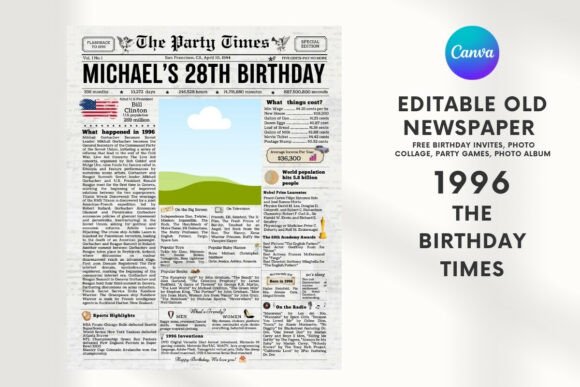
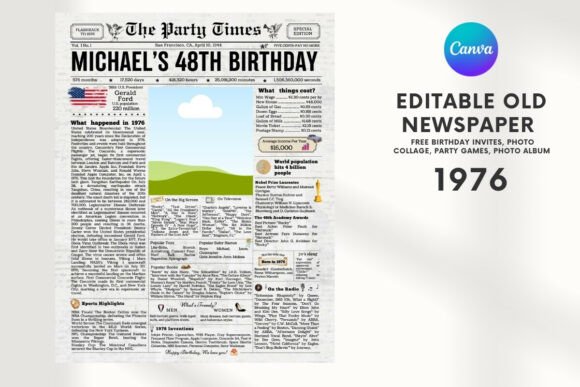
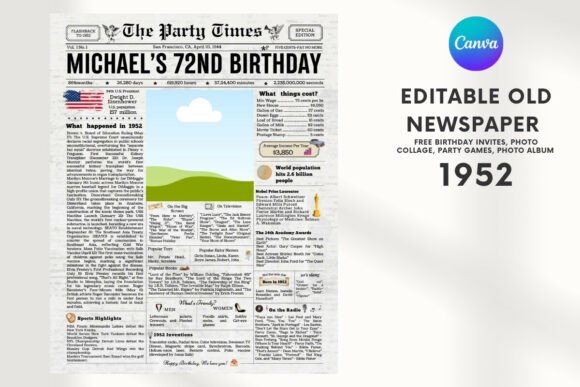
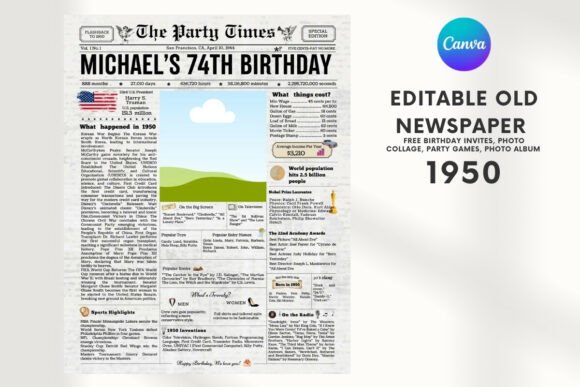
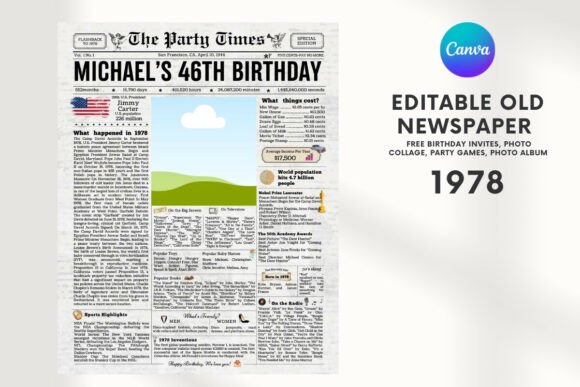
There’s something quietly powerful about holding a newspaper—not as breaking news, but as personal history. The EDITABLE 1978 Birthday Vintage Newspaper taps into that resonance: a thoughtfully designed Canva template that transforms a birthday into a tactile, nostalgic narrative. It’s not just a printable—it’s a curated storytelling tool. Born from the aesthetic warmth of late-1970s typography, layout, and design sensibility, it invites users to assemble a personalized “front page” for someone’s life: headlines celebrating milestones, weather reports quoting favorite childhood memories, society columns spotlighting family and friends, and even mock obituaries (playfully titled “In Celebration of Life So Far”). This isn’t retro for retro’s sake. It’s vintage framing with modern utility—designed for people who value meaning over mass production, and craftsmanship over convenience.
Why Nostalgia Is Becoming a Design Language—Not Just a Decoration
Nostalgia has shifted from background motif to active communication strategy. In an age of algorithmic feeds and ephemeral content, tangible artifacts carry emotional weight. A 2023 Pew Research study found that 68% of adults aged 25–49 actively seek out analog experiences—vinyl records, film photography, handwritten notes—to counter digital fatigue. The EDITABLE 1978 Birthday Vintage Newspaper fits squarely within this movement—not as escapism, but as intentional grounding. Its 1978 styling isn’t arbitrary: that year sits at a cultural hinge—post-disco, pre-digital, rich in analog texture and human-scale design. Think warm halftone dots, serif-heavy headlines, subtle paper grain overlays, and column widths that invite slow reading. For creators and planners, this isn’t about pretending the internet doesn’t exist; it’s about using visual language to signal care, attention, and time invested—qualities increasingly rare, and therefore increasingly valued.
From Static Invite to Living Memory Archive
Traditional birthday invitations serve one function: logistics. The EDITABLE 1978 Birthday Vintage Newspaper expands that role. It can be a centerpiece at a milestone party (think 30th, 50th, or 75th), a conversation starter at a family gathering, or even a quiet keepsake slipped into a framed photo album. Educators have adapted versions for student-led autobiographical projects; small business owners use modified layouts to celebrate team anniversaries; wedding planners integrate them into “story wall” displays. One freelance graphic designer shared how she used the template to create a 60th birthday “retrospective” for her father—including scanned ticket stubs, quotes from old letters, and a “classifieds” section listing his lifelong hobbies (“Seeking: more time to garden, less time to mow”). That flexibility is built in: editable text boxes, resizable image placeholders, and layered design elements mean no two newspapers look alike—even when starting from the same base.
How Canva Makes Thoughtful Customization Accessible
Historically, designing a publication like this required desktop publishing software, print knowledge, and hours of layout work. Today, the barrier is near-zero. Canva’s intuitive drag-and-drop interface, real-time collaboration features, and cloud-based asset library let users focus on content—not kerning. You don’t need to know CMYK from RGB to adjust margins or swap fonts. What matters is selecting the right photo of the celebrant at age 7, choosing a headline tone (“Local Hero Turns 45” vs. “Community Pillar Celebrates Five Decades”), or deciding whether the “sports section” highlights their tennis wins or their legendary backyard BBQs. This democratization aligns with broader workflow shifts: professionals juggle multiple roles, creators ship faster without sacrificing authenticity, and busy parents want meaningful—but manageable—ways to celebrate loved ones. The template doesn’t ask you to become a designer. It asks you to become a curator.
Practical Tips for Getting the Most Out of the Template
Start with intention—not decoration. Ask: What story do we want this newspaper to tell? A 30th birthday might lean into humor and early-adult milestones (first apartment, first job, first road trip). A 70th may emphasize legacy, resilience, and intergenerational connections. Here’s how to translate that into action:
- Gather before you design. Collect 5–7 key moments—photos, dates, quotes, inside jokes. Scan physical items (report cards, concert tickets) or pull screenshots of meaningful social media posts.
- Respect the grid—but don’t fear bending it. The template uses classic newspaper columns for readability, but feel free to merge cells for a full-width “cover photo” or add a pull quote box in the margin.
- Write like you speak. Avoid stiff phrasing. Instead of “The honoree was born on March 12, 1978,” try “Born under a full moon and raised on Saturday morning cartoons.”
- Print smart. Use matte or uncoated cardstock for authenticity—not glossy photo paper. If mailing, test foldability first; some users trim and staple theirs into a mini broadsheet format.
- Extend the experience. Pair the printed newspaper with a QR code linking to a private video montage or Spotify playlist titled “The Soundtrack of [Name]’s Life (So Far).”
Beyond the Birthday: When Personal Archiving Meets Everyday Creativity
The rise of templates like the EDITABLE 1978 Birthday Vintage Newspaper reflects a deeper shift: people are becoming more deliberate archivists of their own lives. Social media captures fragments; tools like this help synthesize them. Teachers use similar frameworks for “life timeline” units. HR teams adapt them for onboarding welcome kits. Genealogists repurpose sections to visualize family migration patterns. What began as a birthday tool now functions as a low-stakes entry point into narrative design—teaching users how to structure stories, prioritize details, and balance fact with feeling. That skill transfers. Whether you’re drafting a grant proposal, building a portfolio website, or preparing a client presentation, knowing how to lead with voice and structure with clarity matters. This template doesn’t just commemorate a birthday—it quietly strengthens those muscles.
A Realistic Take on Longevity and Impact
Will every user print and frame their creation? No. But many do—and more importantly, many report that the *process* of making it deepens connection. One small business owner told us she spent three evenings assembling her partner’s 40th birthday newspaper while listening to interviews he’d given years ago. “I wasn’t just designing,” she said. “I was re-reading his values, remembering what made him laugh, noticing patterns I’d missed.” That kind of reflective engagement is hard to replicate with a generic e-invite. And while trends come and go, the human need to say, “You matter—and here’s proof, in ink and intention,” remains constant. The EDITABLE 1978 Birthday Vintage Newspaper meets that need without demanding expertise, excess time, or a big budget. It meets people where they are: capable, caring, and looking for ways to mark time that feel both grounded and joyful.
Getting Started Is Simpler Than You Think
You don’t need a design degree, a printing press, or even a clear vision on day one. Open the Canva template. Duplicate it. Rename it “[Name]’s Life Edition, Vol. 1.” Add one photo. Write one sentence. Save. Come back tomorrow. The power isn’t in perfection—it’s in participation. In choosing to honor someone not with a fleeting message, but with a crafted artifact that says, “Your story is worth the space on the front page.” That’s the quiet strength of the EDITABLE 1978 Birthday Vintage Newspaper: it turns celebration into curation, memory into medium, and birthdays into heirlooms—starting with a single, editable click.