Miscellaneous Objects and Infographic El
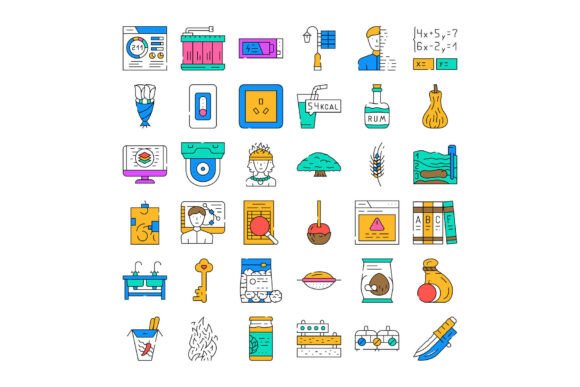
Miscellaneous Objects and Infographic El refers to a curated digital asset collection comprising colorful line art icons that span a broad spectrum of objects, symbols, and infographic elements. These icons are designed with clean, scalable vector lines and consistent stylistic traits—such as uniform stroke weight, rounded terminals, and a cohesive color palette—making them suitable for integration into presentations, dashboards, reports, websites, and mobile interfaces. Unlike highly specialized icon sets focused on a single domain (e.g., finance or healthcare), this collection emphasizes conceptual diversity: it includes icons representing abstract ideas (e.g., growth, connection, balance), everyday items (e.g., coffee cup, notebook, cloud), data visualization components (e.g., bar chart segments, flow arrows, timeline markers), and thematic symbols (e.g., globe, lightbulb, handshake). The “El” in the name likely denotes “elements,” reinforcing its role as a modular toolkit rather than a fixed system.
Designers, educators, product managers, and content creators often explore Miscellaneous Objects and Infographic El when they need visual variety without sacrificing stylistic unity. Its appeal lies in flexibility—not in replacing comprehensive design systems, but in filling gaps where off-the-shelf icons fall short. For example, someone building an internal training module on cross-functional collaboration may struggle to find a single icon set that includes both a “teamwork” symbol and a stylized “whiteboard” or “feedback loop” element. This collection offers those less-common but contextually meaningful representations without requiring custom illustration.
One practical benefit is time efficiency. Because the icons share consistent line weight, spacing, and color logic, users can mix and match across categories without extensive manual adjustment. This reduces the need for reworking assets to match tone or scale—especially helpful when iterating rapidly across slides, prototypes, or documentation. Additionally, the use of color within line art (rather than flat fills) supports visual hierarchy: key concepts can be emphasized through hue while maintaining readability at small sizes. The collection also tends to avoid culturally narrow metaphors—for instance, favoring a generic “document stack” over region-specific paper formats—enhancing its utility in global-facing materials.
However, there are tradeoffs to consider. First, breadth can come at the expense of depth: while the set includes many object types, it may lack nuanced variants (e.g., multiple states of a “warning” icon—active, disabled, hovered) or fine-grained semantic distinctions (e.g., different kinds of “network” icons for technical vs. social contexts). Second, because it prioritizes visual harmony over strict functional categorization, users may spend more time searching for a precise concept than they would in a rigorously taxonomized library. Third, licensing terms vary by source; some versions permit commercial use with attribution, while others restrict redistribution in editable formats—making it essential to verify usage rights before embedding icons into client deliverables or SaaS products.
Expectations should align with the collection’s intended scope. It is not a replacement for accessibility-optimized icon fonts with built-in ARIA labels, nor does it include animated or interactive variants. Users should not expect SVGs pre-configured for dark mode contrast or responsive scaling via CSS variables unless explicitly stated by the provider. Similarly, while the icons are generally legible at 24–48px, extreme reduction (e.g., below 16px) may compromise clarity due to the interplay of color and thin strokes.
Miscellaneous Objects and Infographic El is a strong fit when your project calls for expressive, non-generic visuals across varied subject areas—and when consistency matters more than exhaustive coverage. It works well for internal knowledge bases where brand guidelines allow stylistic latitude, educational infographics targeting general audiences, pitch decks needing quick visual reinforcement, or early-stage UX wireframes where fidelity is secondary to concept communication. Teams using tools like Figma or Adobe XD will find the vector format easy to recolor, layer, or combine with text callouts without breaking alignment.
Conversely, alternatives may be preferable in several situations. If your work demands strict adherence to WCAG contrast standards, a monochrome or high-contrast icon set with documented luminance ratios may serve better. For enterprise applications requiring icon governance—such as consistent naming conventions, version-controlled SVG sprites, or automated linting—dedicated design system libraries (e.g., IBM Carbon, Google Material Symbols) offer greater structure and long-term maintainability. Likewise, if your content relies heavily on metaphorical or domain-specific imagery—like medical anatomy, engineering schematics, or legal seals—a specialized set will provide more accurate, vetted representations than a general-purpose collection.
When evaluating whether Miscellaneous Objects and Infographic El meets your needs, begin by auditing your current visual gaps. List three to five recurring concepts in your recent projects that lacked suitable icons—or required disproportionate customization. Then sample the collection: do at least two of those concepts appear with appropriate visual clarity and stylistic compatibility? Next, assess workflow integration. Can you import and recolor assets directly in your primary tool? Does the file organization (e.g., folders by category, consistent naming) support efficient discovery? Finally, review licensing in context: if you’re producing client-facing deliverables, confirm whether the license permits derivative works or requires visible attribution in final outputs.
It’s also worth comparing how this collection handles edge cases. Try rendering a group of icons side-by-side at three sizes (24px, 32px, 48px) against light and dark backgrounds. Note whether stroke definition holds, whether color differentiation remains effective, and whether alignment between related icons (e.g., “input” and “output”) feels intentional. Small inconsistencies—like mismatched baseline positioning or uneven spacing around bounding boxes—can compound across layouts, affecting perceived polish.
In summary, Miscellaneous Objects and Infographic El serves a distinct niche: it supports communicative versatility without demanding full custom illustration. Its value emerges not from comprehensiveness, but from thoughtful curation across themes and forms. Readers deciding whether to adopt it should weigh their need for conceptual range against requirements for technical precision, scalability, and governance. When aligned with realistic expectations—and used as one component among several visual resources—it can meaningfully reduce friction in conveying complex ideas through clear, cohesive imagery.